Costa Cruises’ 2026-27 South American season will mark the return of the Costa Serena to the region after a 15-year absence.
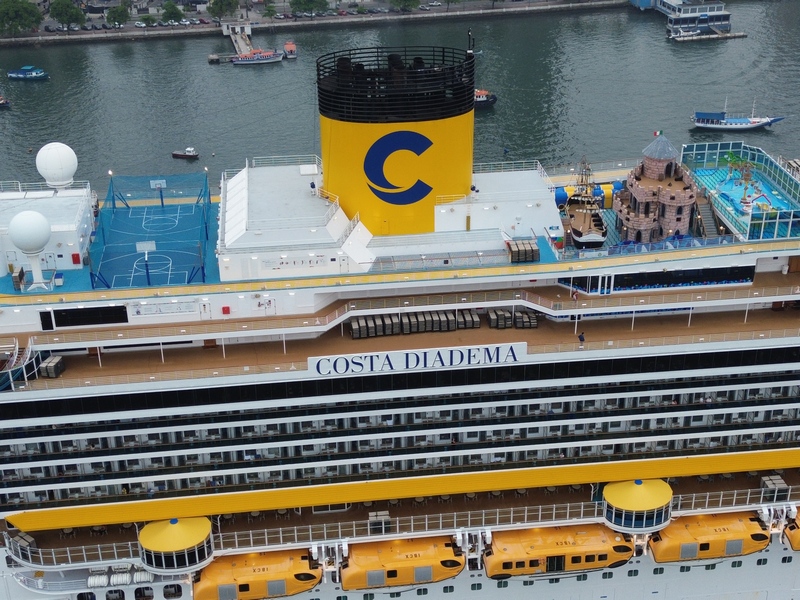
Speaking to Cruise Industry News in Brasília, Renê Hermann, Costa’s institutional president for Brazil, said the ship will join the Costa Diadema for itineraries to Brazil, Argentina and Uruguay.
Ending a decade-long stint in Asia, the Serena will reach South America at the end of a world cruise, which Hermann described as another highlight of the deployment.
“It leaves Tokyo (Japan), stops in Chile, sails through Tierra del Fuego and ends in Buenos Aires on December 22, 2026,” he explained.
The 2007-built ship will then take over some of the itineraries the Costa Favolosa sailed in the region in 2025-26, with seven- to nine-night cruises from Buenos Aires and Rio de Janeiro.
The Serena’s season will be significantly shorter and will not include the three- and four-night cruises the Favolosa offered from Santos in November and December 2025.
“In other words, we unfortunately lost what the Favolosa had in the previous season regarding short cruises,” Hermann said.
He said Costa hopes to restart this program in the future, but any capacity increase will depend on the availability of ships and itineraries.
“We will try to see if we can recover it. Because it is not something good, even for the destinations in the country. It is bad for cruise terminals, where there are fewer passengers, which impacts everything else,” he explained.
Brazil’s Northeast coast, long a popular cruise destination, will be left off Costa’s regular itineraries for a third consecutive season in 2026-27.
Hermann said the company plans to return eventually, noting that the region was a fixture of Costa’s itineraries for decades.
“Plans for that always exist. Salvador, Ilhéus and Maceió are wonderful destinations. I’m sure one day we will have to return. But, for that, we need to see operational costs lowering, so we can justify making the investment of having a ship doing an itinerary like that,” he explained.
Hermann also confirmed Costa will extend its Sea Destinations initiative to South America, with two themed onboard parties off the Brazilian coast.
“We’ll be offering these experiences in Copacabana and Balneário Camboriú, just as we’ve been doing in Europe since 2024,” he explained.
As previously reported by Cruise Industry News, both Sea Destinations are part of the Costa Serena’s schedule this season.
“The ship already has authorization from the Brazilian Navy to remain anchored in Copacabana, so that we can throw a party for the passengers onboard and, from the deck, they can enjoy the view of Copacabana,” he said, referring to the Rio de Janeiro beach.
“The same goes for Balneário Camboriú, with the ship leaving where it normally anchors and going to the city center to stay anchored there while we also throw a party onboard,” Hermann added.
Alongside the Serena, Costa’s South American season includes the Costa Diadema, which will offer three- to seven-night cruises from Santos, Itajaí and Buenos Aires.
Hermann said that the Sea Destinations initiative could expand to other ports in the region if it is well received.
“In reality, the Sea Destination is a destination in the middle of two destinations. So, we managed to build a new destination here between Rio de Janeiro and Ilhabela, in the case of Copacabana,” he noted.
In August, Costa announced a leadership change for the region, with Dario Rustico, president for the Americas, stepping down after more than five years.
Hermann said the transition is not expected to significantly affect the company’s operations in the region.
“Jorge Serrano de Vidales arrives in early January, but the operational staff already has everything ready for the season, so absolutely nothing will be changed,” he said, noting that Rustico decided to leave Costa to pursue personal goals.
Currently leading trade sales for Costa in Spain and Portugal, Serrano will take over the role in January 2027.
“We’ll have continuity. Costa will continue in Brazil, will continue in Argentina, will continue in Chile, in the Americas and everywhere else,” he added.