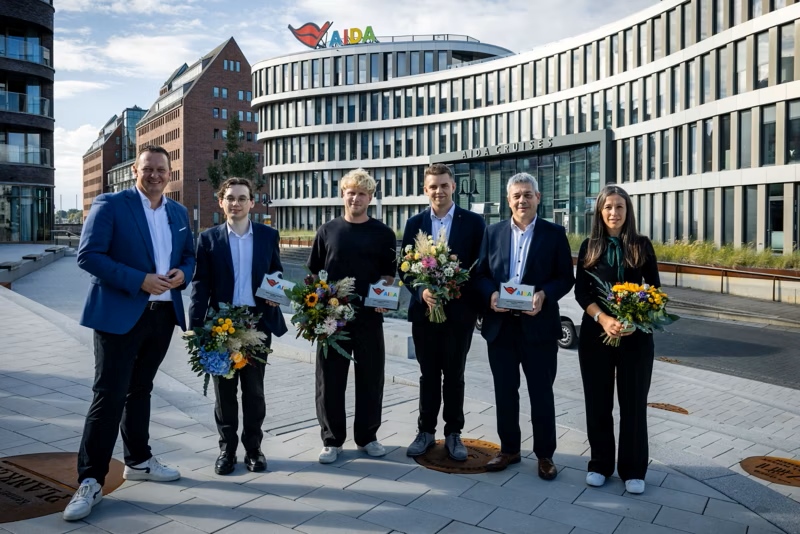
AIDA Cruises has selected three winners of its Innovation Hub competition, fostering innovative solutions for the future of the maritime industry.
A total of nine finalists presented their concepts at the AIDA headquarters in Rostock on September 16, having previously qualified for the final round through an application process with over 150 ideas.
The winners will now have the opportunity to further develop their ideas together with AIDA as part of an implementation study or to test them as a pilot project onboard the AIDA fleet.
“Today we witnessed how concrete ideas for the future of cruising are emerging from a wide range of perspectives,” said Dirk Inger, senior vice president sustainability at AIDA Cruises.
“The quality and diversity of the concepts presented demonstrate the potential inherent in the exchange between startups, technology companies, academia, and maritime practice. With the three winning projects, we now want to examine the next steps and work together to determine how compelling concepts can be transformed into concrete applications,”
The winners of the AIDA Innovation Hub 2026 per category are:
- Decarbonization: revincus GmbH (Weimar) won with its technology that recovers thermal energy from wastewater and reuses it onboard.
- Sustainability: the German Aerospace Center (DLR) from Stuttgart won with its “WoodShip” project, which investigates how regional wood can be increasingly used in selected ship structures and exterior applications
- AI Tools & Smart Solutions: contagt GmbH (Mannheim) won with its digital indoor navigation system, designed to make it easier for guests to find their way around onboard.
The event also included the panel discussion “Innovative Cruising: Smart Visions for a Strong Future,” during which Christina Hankel, vice president of human resources management at AIDA Cruises, Fabian Feldhaus, CEO and Co-Founder of Flagship Founders GmbH, and Dr. Martin Setzkorn, managing director of the Center for Entrepreneurship at the University of Rostock, discussed technological developments, societal expectations and the framework for the future of the cruise industry.
Key topics included climate goals, digital innovations, smart ports and the industry’s role in shaping a sustainable tourism sector.