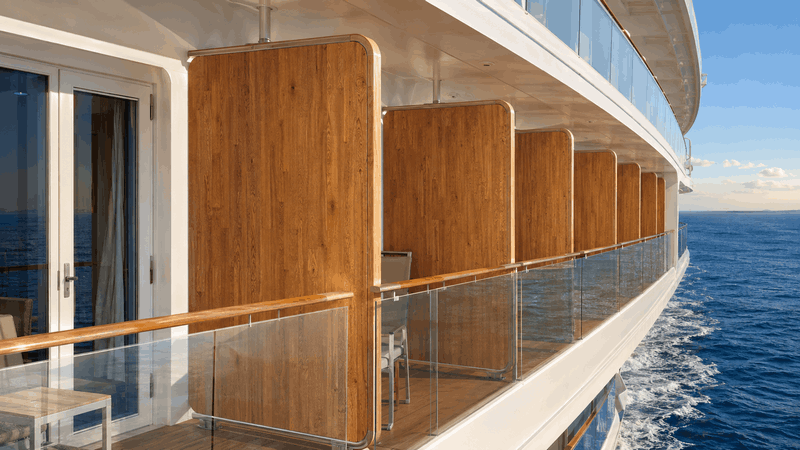
Wood, the material shipbuilders have relied on for thousands of years, could be one of the next lightweight options for cruise ships, according to a German aerospace research center.
The German Aerospace Center, known as DLR, has just won the sustainability category at the AIDA Innovation Hub in Rostock on Sept. 16 with a project called WoodShip.
Nobody is proposing a wooden cruise ship just yet, but what DLR has in mind is wood in selected places, starting with privacy screens, more cladding and also parts of the ships’ balcony area.
But what is an aerospace center doing getting involved with ships at all?
“Well the name ‘Aerospace’ has a lot of historical reasons,” said Dr. Elmar Beeh, head of the materials and process applications for road and rail vehicles department at DLR’s Institute of Vehicle Concepts in Stuttgart.
The institute has mostly researched road and rail vehicles traditionally, Beeh explained, and his department works on lightweight construction and renewable materials.
In 2024 it set up a center of excellence for wood in vehicle structures, with the aim of using wood not just as decoration but as a load-bearing part of vehicles of all kinds and this is where applying it to ships took shape.
Beeh further explains that the rail work turned out to be highly transferable. It doesn’t matter what type of vehicle it is but how the wood is designed and validated to meet the relevant safety requirements.
“It is precisely this knowledge that we have now applied to shipbuilding,” he said.
The reasoning for the starting point is practical, and Beeh was clear the work on exactly where wood can go is still an ongoing investigation.
Their proposal is to start with components that are only semi-load-bearing which means privacy screens, cladding and balcony-area parts, since they all sit on the exterior, see much less structural stress and are therefore relatively more easy to repair.
Beeh gave the density of beech at around 700 kilograms per cubic meter and light woods like albasia at roughly 250 to 400, against what is generally used which is about 7,800 for steel.
He said the team’s experience in rail vehicles suggests the approach can cut weight by around 30 percent for ships.
The gain matters most up on high, where the upper decks are, and where less weight could also mean lower fuel consumption and fewer emissions over time.
Fire safety is the reason timber was historically kept out of shipbuilding, Beeh acknowledged, and it’s the hurdle the team wants to clear outright.
Rail is proof that it can actually be done, he said. DLR’s wood-based materials already meet the incredibly strict fire requirements of the European railway standard DIN/EN 45545, and to multi-story timber buildings, where comparable problems have been solved for years.
In the team’s demonstrator it reached the required hazard levels using impregnated beech plywood combined with both metal or plastic cladding.
Ships have a different rulebook though, and Beeh said the evidence would have to be provided under exact ship-specific regulations.
In practical terms that would mean fire tests on specific components of the ship, setting up and then adapting certification guidelines for timber parts in shipbuilding, and approval from the relevant classification societies.
DLR also expects a dedicated fire laboratory to open in early 2027, he said, where timber components can be tested under realistic conditions, which he called an important prerequisite for going down this road.
AIDA has not committed to putting wood on any of its ships, just yet.
The cruise line said the winners can develop their ideas further with the company in an implementation study or test them as pilot projects onboard the fleet, and that only those steps will show which solutions will actually work technically and economically.
Beeh described this as the same position from DLR’s side.
His team’s next step now is to deepen the collaboration more, pick specific use cases and then test subjects, and define an overall framework for a joint study or pilot phase.
For the research team the award was partly a matter of much pride, but mostly a lot of validation for us, Beeh explains.
“It is above all confirmation that our approach is working,” he said, adding that the insights from rail can indeed be applied to new sectors.
It also gives the team a chance to check its findings for the very first time in a maritime operating environment, which he described as of enormous value for developing the technology much further.
Five years from now, Beeh would like to see WoodShip out of the laboratory and onboard, with the first timber components in series production, reliable operating data from day-to-day ship life, and a clear picture of which parts can be used in larger quantities in a more standardized way.
If that works out , the next step would be spreading to other ships, since the building blocks can have then be adapted to different sizes of vessel.