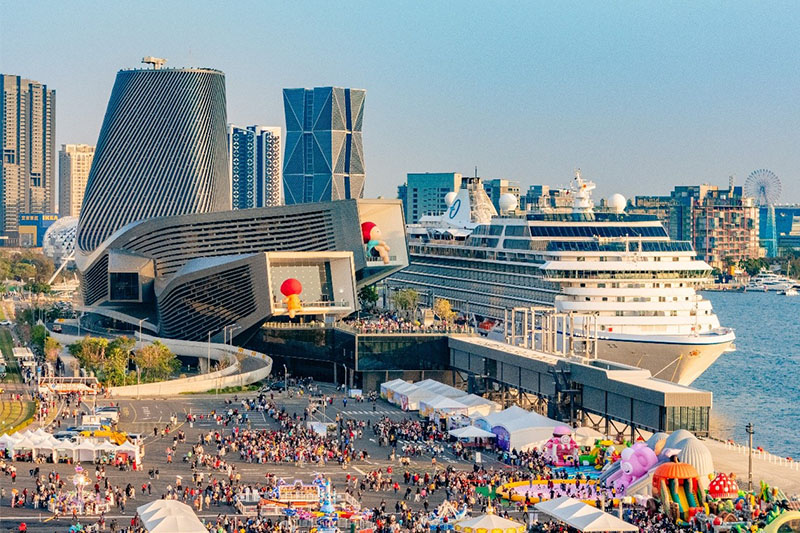
Taiwan Ports are gearing up for 2027, offering cruise callers upgraded facilities.
Penghu International Cruise Terminal is scheduled to open in early 2027. It will be able to host ships up to 150,000 tons.
Keelung Port will initiate the phased redevelopment of its East Cruise Terminal and surrounding waterfront, eventually accommodating two ships of up to 250,000 tons simultaneously.
Additionally, high-capacity shore power facilities are currently under construction across Keelung and Kaohsiung ports for next year.
Joe Y. Chou, chairman of Taiwan International Ports Corporation (TIPC), said TIPC plans to roll out an AI-powered travel customer service system to enhance terminal services and that a smart crowd monitoring and security system will be deployed concurrently to analyze and refine passenger, immigration, boarding, baggage handling and ground transport flows.
2027 and Beyond
According to Chou, Taiwan’s cruise market has continued a steady growth trajectory in 2026, aligning with expectations and bringing a positive outlook for the full-year season.
By the end of July, passenger volumes exceeded 800,000, a 22 percent year-on-year increase.
Keelung Port accommodated three cruise ships simultaneously for the first time in seven years. The port also welcomed inaugural calls from Ritz Carlton’s Luminara and the AIDAdiva. Kaohsiung Port also welcomed the MSC Bellissima for her homeport debut.
Next year’s outlook is even more positive, with increasingly diverse callers, said Chao. Taiwan is also transitioning toward a two-tiered growth model that integrates homeport operations and transit port services.
Taiwan’s competitive edge, according to Chao, comes from strong port infrastructure and its strategic position at the crossroads of Northeast and Southeast Asian ship routes.
“Major hubs like Keelung and Kaohsiung continue to elevate their homeport capabilities, and emerging ports are actively expanding international transit itineraries,” added Chao, who noted that Taiwan is set to play a far more dynamic role in Asia’s overarching cruise network.
Forecasts expect 305 cruise ship calls, and port calls and passenger volumes are projected to grow 7 percent and 4.3 percent, respectively, compared to last year.
Measuring Performance
A port’s operational performance is intrinsically tied to cruise company partnerships.
“Understanding their operational needs, gaining early visibility into deployment schedules and market trends, and seamlessly integrating port facilities, passenger services and regional tourism resources to help them design highly competitive itineraries is crucial,” Chao said.
Port terminal signage is rendered in traditional Chinese, English, Japanese and Korean, paired with universal design pictograms.
The terminals offer barrier-free infrastructure, nursing rooms and family-friendly spaces to accommodate diverse age groups and mobility needs.
According to Chao, terminals also integrate real-time schedules for regional railways, high-speed rail and bus networks.
To reduce waiting times, Automated Immigration Clearance Lanes (e-Gate) access was opened to all foreign cruise passengers in June. e-Gate lanes were added at Keelung, which now features 12 lanes, as well as Kaohsiung, which now has eight.
TIPC has also curated tiered itineraries, such as port and city tours, which are tailored to cruise schedules and passenger preferences, Chao said.