New York’s Manhattan Cruise Terminal (MCT) is due for a major overhaul, and the need for more space was a key topic of “The Next Wave of Cruise,” a seminar organized by New York Maritime (NYMAR) and Cruise Lines International Association (CLIA) and hosted by law firm Holland & Knight.
The New York City Economic Development Corporation (NYCEDC), which oversees the terminal, first presented a master plan for the site in late 2025 and is now refining it.
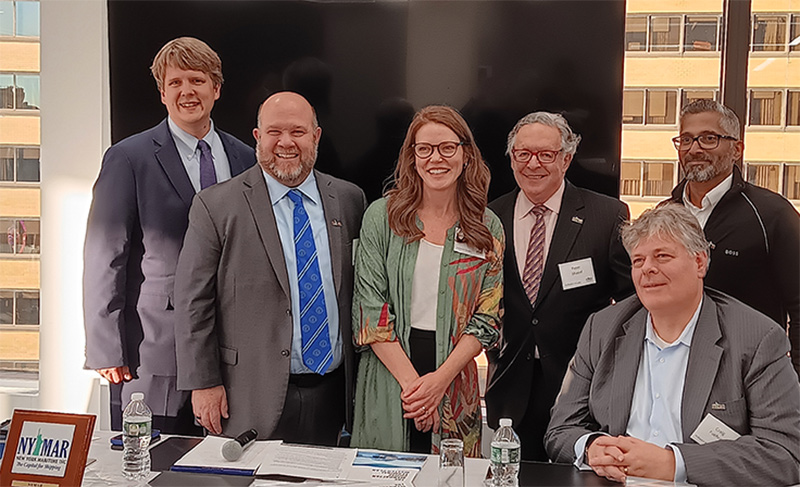
Moderated by Nicholas Kaasik, senior counsel at Holland & Knight, the panel included Bud Darr, president and CEO of CLIA; Allison Dees, vice president and head of New York City’s cruise portfolio at NYCEDC and Craig Fuehrer, managing director and head of transportation investment banking at Deutsche Bank Securities.
The discussion centered on New York, where NYCEDC operates MCT and the Brooklyn Cruise Terminal.
“For us, cruising is an important part of New York City’s economy … and an incredibly important part of what the city has to offer,” Dees said.
MCT handles about 1 million passengers a year, roughly half of them from out of town and spending on hotels, meals and shopping before and after their cruises.
That volume brings challenges in managing crowds and vehicle traffic around the terminal, and bigger ships are on the way.
“We know that the lines have larger ships that will be landing around 2032,” Dees said. “We typically see one step down from the largest ships.”
“We are short on space; even where we can handle the actual ship, we are struggling on the upland side, with the amount of people, and handling that number of people in a way that does not negatively impact the surrounding community,” she explained.
Dees, who previously worked on NYCEDC’s ferry service connecting the city’s boroughs, said the agency has held extensive talks with neighborhood groups and industry partners, including cruise lines and local service providers such as tugboat companies, as the plan moves forward.
“The biggest thing,” she said, “we need more space.”
Fuehrer, who has extensive experience financing container terminals in the Port of New York and New Jersey, focused on the city’s value proposition, noting the large population surrounding New York.
“It’s about creating the right experience – that’s what’s going to draw the people,” he said.
On financing, Fuehrer said infrastructure funds, such as those that have backed the port’s container terminals, look for off-take commitments.
“You have to develop some trunk load of committed capacity that you can finance off of,” he said. “It’s no different from the container ports here at the Port of New York, where you have to get these (cruise ships) guys to commit to slots that you can potentially securitize.”
Shore power was another key topic.
Dees noted that the Brooklyn Cruise Terminal already offers shore power, allowing ships to plug into the local grid rather than run onboard diesel generators while docked.
“The city is definitely committed to shore power,” she said. “It makes sense to shore power from both a local particulate but also a greenhouse gas perspective.”
NYCEDC is also planning shore power for a redeveloped MCT.
“We are working closely with Con Edison to be able to have shore power at three berths,” Dees said, adding that the agency is working to supply shore power at the existing site as well.
LNG bunkering, currently not permitted in the port, is also on Dees’ radar. Pointing to upcoming calls by Disney Cruise Line’s LNG-powered Wish-class ships, she said the city would need to work with the U.S. Coast Guard and the New York City Fire Department to bring LNG into the fueling mix.
“We’d love to get there,” she said.
The Manhattan Cruise Terminal Master Plan is available at edc.nyc/project/manhattan-cruise-terminal-master-plan.