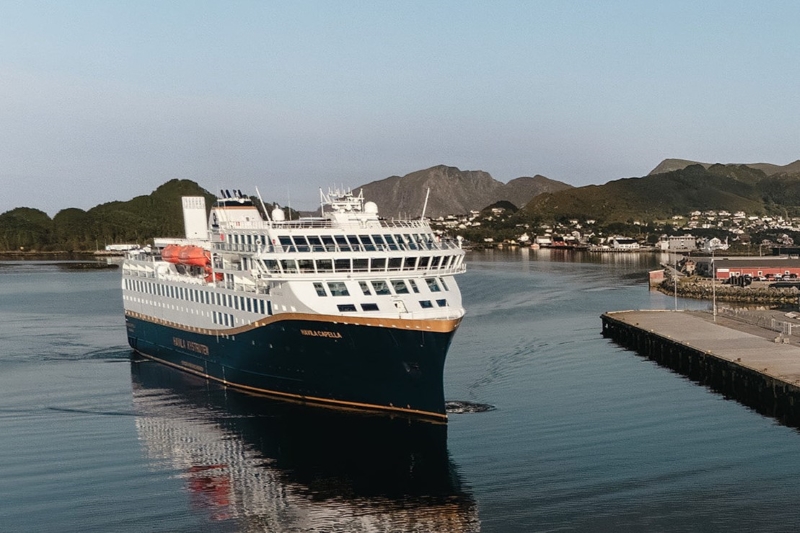
Havila Voyages is putting planned investments on hold due to the Norwegian government’s proposal to cut the next contract for the coastal route in Norway from ten years to four or five years.
This includes modifications that would make it possible to handle private cars at all ports, the cruise line said in a press release, warning that the proposal will affect jobs, settlement, emissions cuts and emergency preparedness.
In its proposed national budget for 2027, which will be voted on in December, the government proposes reducing the contract period for the Bergen–Kirkenes coastal route from ten years to four or five years after 2030.
The new framework will form the basis for the tender, which is expected to be issued in the first half of 2027.
“A ship is built to sail for decades. A four- to five-year contract provides no basis for investing in new ships or major technological advances. We therefore have to put some investments on hold and reconsider others pending clarification,” said Bent Martini, CEO of Havila Voyages.
Havila Voyages believes such a short contract will in practice limit competition to today’s operators and their existing fleets, as well as ultimately be more expensive for the state itself.
Martini explained that short contracts are normally more expensive, because the investments must be recouped over a shorter period.
Havila also objected to the government’s proposed climate requirements. The Ministry of Transport writes that climate requirements beyond those in legislation should only be set where the abatement cost justifies it.
“If the next contract does not set clear requirements, or give us time to invest in better solutions, Norway as a maritime nation risks halting a development that is already underway. The government must use its purchasing power to drive renewal and major emissions cuts,” Martini continued.
Havila noted that it believes that a shorter contract, weak climate requirements and new assessments of the coastal route in the National Transport Plan together create uncertainty about the route’s future, leaving the door open to discontinuing it after 2035.
“We have always built to stay. Ships, people, and jobs along the coast are not something you build up in four or five years, and you do not get them back once they are gone. A contract this short gives no reason to invest. Then it is not the shipping companies that lose – it is the local communities that depend on the ships arriving every day,” added Havila Voyages founder Per Sævik.