
Every hot shower on a cruise ship ends the same way, with the heat going straight down the drain.
But revincus, a small startup from Weimar, Germany, thinks that it can catch some of it, and after winning the decarbonization category at the AIDA Innovation Hub awards in Rostock on Sept. 16 it’s already well into a study with the cruise line to find out how.
“We are, in fact, already well into the implementation study,” said Felix Drechsel, co-founder and technical managing director of the company.
The idea itself goes back to a work placement in Finland, which Drechsel did after finishing school, at a company that designed and installed heat pump systems.
There he learned how much a heat pump’s efficiency depends on the temperature of the heat source, and one thing then led to another.
“It occurred to me that waste water must actually be a very interesting heat source,” he explained.
“After all, if you think about it, wherever hot water is used, for example, in residential buildings, swimming pools or even on cruise ships, valuable thermal energy is constantly being wasted as it flows away with the waste water.”
He later met Jeremias Polster while studying in Weimar, where the two explored the idea together, and eventually decided to turn it into a business, building their own heat exchangers to recover the leftover heat.
So far revincus has mostly installed them in larger residential buildings and housing estates and in swimming pools, where they recover heat from shower water and filter backwash, plus some industrial uses such as in the pharmaceutical industry.
However a ship is a new kind of customer.
“I like to compare a cruise ship to a small, floating town,” Drechsel said. “”Onoard, there is practically every type of waste water that is also produced in a town.”
That works in its favor, he explained, because ships already collect greywater and blackwater separately, and the greywater still holds a lot of heat.
Revincus plans to put its system, a wastewater heat exchanger plus a heat pump, downstream of the ship’s greywater treatment plant, so it only ever sees water that has been treated already, and sends the recovered heat into the ship’s heating system.
An initial assessment for selected AIDA ships pointed to around 10 megawatt-hours of usable thermal energy per day, according to Drechsel.
The small problem however is (and Drechsel is up front about it) that while a ship is underway, the engines’ waste heat generally covers what’s needed, so the gain comes mostly from being in port.
“What I find particularly interesting is that we do not need to tap into a new energy source or use additional fuel, but rather utilize heat that is already available on board and which, until now, has been released into the sea without being used,” Drechsel said.
Waste water is indeed a nasty medium for a heat exchanger, as it’s full of solids and fats that clog narrow channels, so ordinary plate or shell-and-tube units tend to block up or lose efficiency fast.
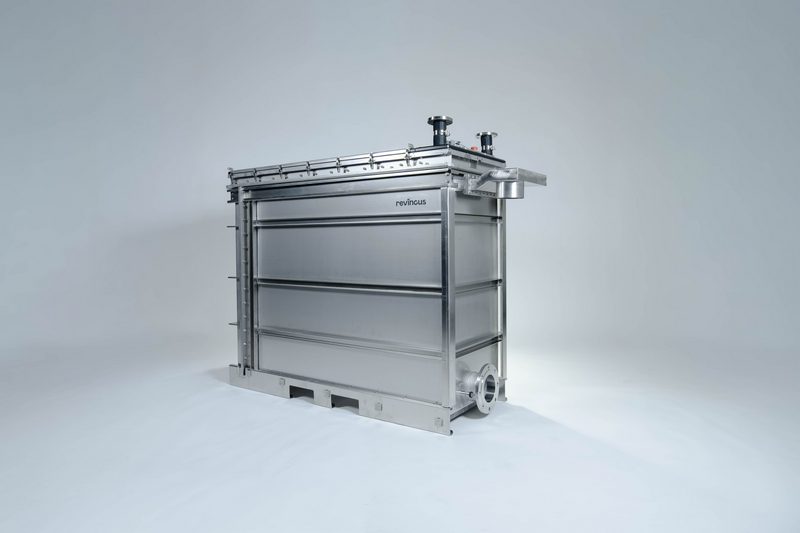
Revincus went a different way, with a larger tank where the waste water sits and stainless-steel plates inside it.
“In principle, you can think of these as flat radiators, except that in our system they work exactly the other way round,” Drechsel explained. “The cooler water flows inside the plates, absorbing heat from the surrounding waste water.”
The heat pump then lifts that heat to a useful temperature.
The real centerpiece is a movable cleaning comb with brushes that travels between the plates and scrapes off deposits, and once the tank is then emptied, the nozzles can spray the plates down as well, all of it automated, with no one having to open the thing up to scrub it by hand.
Treated greywater does mean that there are fewer fats to deal with, however the cleaning is still very much needed, Drechsel explained, because the biofilms will then build up on the plates over time and act like a sort of insulation.
The team has already made an on-site visit to one of the ships in the fleet with AIDA, looking at the technical and spatial conditions.
Space, as ever with a retrofit, is the big worry.
“Unlike with a new build, the technical spaces have already been fully planned out so are occupied accordingly,” Drechsel said.
The visit onboard went well, though, and he said the connection to the existing greywater treatment system looks technically feasible.
The plan now is to use the recovered heat to preheat the fresh drinking water onboard before it’s brought up to hot water temperature.
The team is now designing the system around the space and the real wastewater volumes, sizing components, checking the economics and working through approval and certification, since it goes without saying it has to meet every safety requirement for use on a cruise ship.
If this does indeed work, the idea is that it won’t stop at just one vessel and winning the award has also opened a door revincus had been knocking on for quite a while.
“Back then, we’d already tried to get in touch with various amounts of shipyards to raise awareness of wastewater heat recovery in shipbuilding,” Drechsel said.
“However, as just a small, still relatively unknown company, that wasn’t exactly easy. So it’s all the more wonderful that we’re now working directly with AIDA.”
The five-year goal is to have commissioned the first system on an AIDA ship and then, he hopes, to convince AIDA, Carnival and other cruise lines to retrofit their fleets as well and design heat recovery into all new ships.