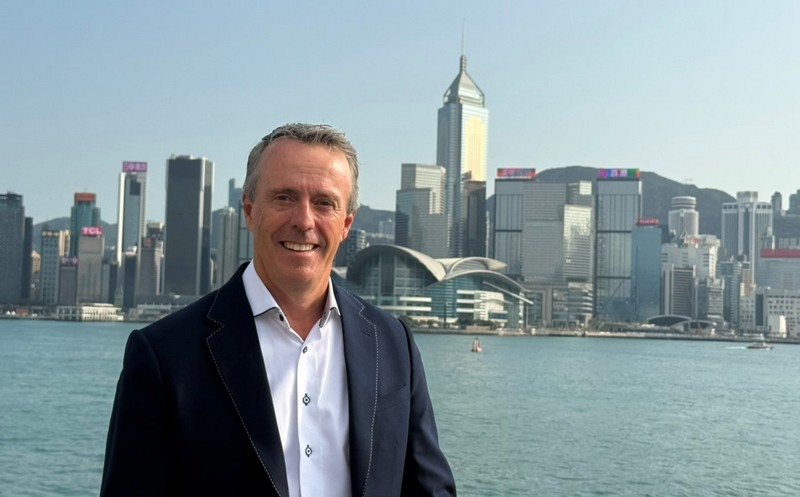
Six months after Ocean Ventures Advisory founder Trevor Young first told Cruise Industry News that Asia was the only real option left for cruise operators shut out of Europe’s booked-up yards, the conversation has moved on from whether Asia can build cruise ships to something more specific, which exact yard, what size, and more importantly, who pays for it.
“I am increasingly hearing from cruise operators, shipyards, designers, suppliers, investors, financial institutions and potential new entrants, so I am seeing the market from several different directions all at once,” Young said.
“That tells me the market is moving now much more from theory towards execution.”
He does, however, not expect a massive wave of large newbuild contracts landing in Asia in the next year.
Smaller- and mid-sized ships will likely come first, he said, with larger vessels following once yards have built up a concrete track record, but he sees the eventual move toward Asia as an inevitability facing the industry.
On cost, Young did push back on the assumption that building in Asia is automatically dramatically cheaper.
Steel, labor and engineering resources are generally less expensive, he said, and China, in particular, benefits from an enormous domestic manufacturing base.
But a cruise ship is not just a hull, and much of its value sits in hotel equipment, interiors, automation and all the thousands of specialist components that are still largely sourced from Europe
“You just cannot simply take the cost of a European cruise ship and assume that Asia will automatically be 30 or 40 percent cheaper,” Young said.
For a properly structured project, he estimated the realistic overall advantage is somewhere between 10 and 20 percent, depending on the vessel, its specification and how well the project is managed
He also said that financing is an underappreciated piece of the whole equation. Maybe even more important to a new entrant as the headline construction price.
Asian yards that can then pair competitive pricing with attractive export credit, banking or leasing structures, he said, particularly in China, will change that calculation considerably.
Young’s timeline for a prototype vessel of around 150,000 tons has become more specific since March, when he offered a rough five-year figure.
He now estimates that it will be around 5.5 to 6.5 years from concept to delivery.
This would be split roughly between two to three years for concept development, specification and contract negotiation, and three to three and a half years for construction and commissioning, assuming the owner, yard and designers are properly aligned from the start.
“Let’s face it, trying to save six months during concept development can easily cost considerably more time and money during the actual construction,” Young explains.
That distinction, between the ship and the final cruise product built on top of it, is where Asia still has the furthest to go.
Building a sophisticated vessel is well within reach for Chinese and other Asian yards, he said.
Building what amounts to a floating resort, hotel, entertainment complex and logistics operation, all at once, is a totally different problem.
“A beautiful restaurant is useless if the galley cannot support it,” Young said. “A spectacular atrium just does not work if your passenger circulation is wrong.”
Europe’s advantage, he said, comes from decades of accumulated, often very painful, lessons across generations of ships, and closing that gap requires cruise-specific expertise embedded from the earliest concept stage rather than brought in after major decisions are locked in.
Among Asian yards, Young pointed to Shanghai Waigaoqiao Shipbuilding as the current leader, citing its progress from Adora Magic City to the recently floated-out Adora Flora City, a 141,900-ton vessel now finishing outfitting ahead of a delivery expected before the end of 2026.
Adora and China Tourism Group have also agreed to a further two-ship program, with an option for a third, targeting delivery before 2030.
Young called China Merchants an interesting name to watch out for, for smaller, more premium and luxury builds, and said he has spent a considerable amount of time also studying Vietnam.
For Vietnam, he cited even more potential for river vessels, expedition ships, superyachts and possibly portions of larger projects.
He explained that this is due to the very competitive labor costs and an already established smaller-vessel track record.
South Korea and Japan have a lot of technical capability, he continued, but the main open question here is that there is more of a commercial appetite rather than actual know-how. Many Southeast Asian yards, just see near-term opportunity mostly in repair, conversion and smaller newbuilds rather than large ocean-going ships.
“The important distinction is between having a large drydock and being a cruise shipyard,” Young noted. “They are just not the same thing.”
On the dynamic between demanding cruise line clients and less experienced Asian yards, Young contends that the risk cuts both ways.
An inexperienced yard may accept too many change orders, he explained, or swing the other way and become too rigid to protect itself from all the risks it does not fully understand.
His answer is the same one he has returned to throughout his career, where you make sure that the concept and specification have matured before the contract is signed. Ambiguity then does not become someone’s cost, delay or argument later.
Young described his own role as strongest in the concept-to-contract phase. He typically represents the owner, though he sees a growing opportunity to advise Asian yards once the contracts are signed, whereby he helps them navigate an owner’s requirements through construction.
Having worked on more than 25 large cruise ships over nearly three decades, he said the throughline in his advisory work is really simple.
“If the right experience is not brought in early enough, well then, the problems do not just magically disappear,” Young said. “They are going to simply move downstream, where they become considerably more expensive and so much harder to correct.”
Asia, in his view, does not necessarily need to copy Europe’s model to compete with it.
He pointed to modularization, standardization, digital engineering and series production as areas where Asian yards could develop their own unique approach, built around a manufacturing supply chain that Europe, at present, does not have at the same scale.
“Europe obviously still leads cruise innovation,” Young said. “Asia though, can become the industry’s next great shipbuilding center.”
Whether that center rises in Shanghai, Hai Phong or elsewhere, Young’s message is clear. The conversation is no longer about whether Asia can build cruise ships, but when and for whom?