Antarctica21 has published its first Sustainability Report.
Titled “Ambassadors of the White Continent,” it documents how the company measured and managed its environmental, social and economic impact during its 2025-26 fiscal year.
The full report is available here and the executive summary here.
It sets a measurable baseline for the company and was prepared in accordance with GRI Universal Standards 2021, incorporating SASB indicators applicable to the cruise sector.
It reports on 104 indicators aligned with the company’s Sustainability Policy, which features a roadmap that runs to 2033, the year of Antarctica21’s 30th anniversary.
“This new Sustainability Report is a tangible proof of our commitment to operating our expeditions and our business with excellence, responsibility, transparency, and a long-term vision,” said Verónica Peragallo, CEO of Antarctica21.
“This is the beginning of a new chapter, one in which we will continue to learn, measure our impact, and raise our standards while meeting the responsibility of exploring one of the most extraordinary and sensitive places on the planet. For Antarctica21, beyond this report, sustainability is built every day by each member of our teams.”
During the 2025-26 season, Antarctica21’s total carbon footprint of 6,878 tCO2e, measured across Scopes 1, 2, and 3, was fully offset through certified credits tied to renewable energy projects in Chile.
The company completed a second consecutive season running its Zodiacs on e-fuels, the world’s first operator to use synthetic fuel in Antarctica.
Furthermore, solar panels at Explorers House, its expedition center in Punta Arenas, covered 44 percent of the building’s energy consumption.
In addition, 25.4 percent of all supplier spending went to businesses in the Magallanes Region, while the Antarctica21 Foundation reached 4,000 direct beneficiaries during the season.
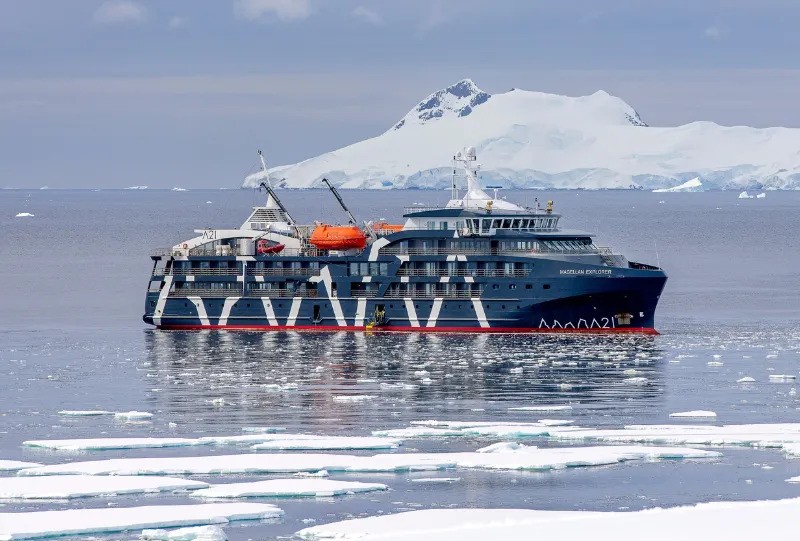
In the report, the company stated that the construction of the Magellan Explorer, the first hybrid-electric polar cruise ship in the Americas, under construction at the ASENAV shipyards in Valdivia, is over 90 percent complete.
On April 19, 2026, the vessel completed its first autonomous navigation on the Calle-Calle River, in Valdivia, marking the first time it sailed using its own propulsion system, representing as a key step ahead of the start of sea trials.
As previously reported by Cruise Industry News, the Discoverer is scheduled for delivery on September 30, with an inaugural voyage set for December 15.