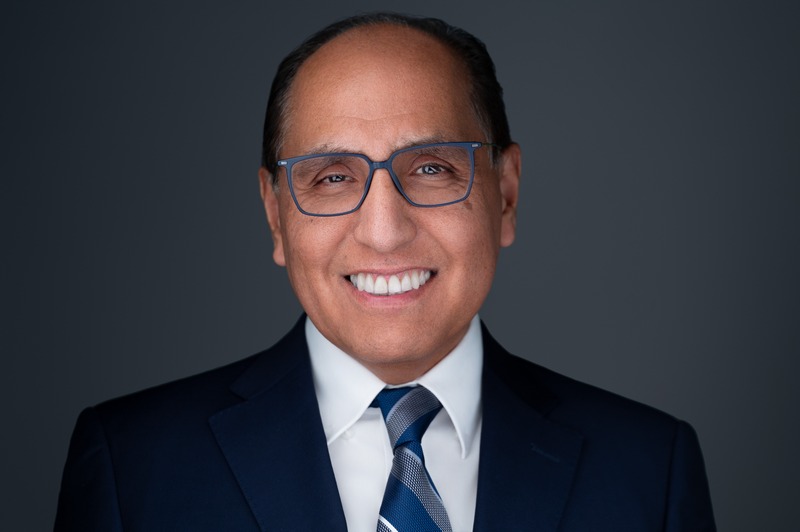
When Miguel Reyna talks about building a cruise terminal, he rarely starts with the concrete, the berths or the luggage halls. He starts with the people who live nearby.
“Whenever I go to a destination, I always meet with all the local stakeholders, talk to the people,” said Reyna, chief development officer at Cruise Terminals International (CTI). “The residents have the local recipe. They usually know what works and what doesn’t work. So by listening to them, we make the job of planning easier.”
That instinct, treat a terminal as a destination rather than a pier, sits at the heart of how CTI is positioning itself. Formed in 2022 as a joint venture between Royal Caribbean Group and funds advised by iCON Infrastructure, the company was set up to close a widening gap between the industry’s orderbook of megaships and the ports able to handle it.
“Royal Caribbean is a cruise company. They invest in building cruise ships and delivering amazing vacations, and this is their primary focus,” Reyna said. “In order for Royal to continue to expand their deployment around the world, they needed support with the development of cruise infrastructure. A cruise line building ports is probably not the best setup. So Royal Caribbean decided we should have a company that can actually deliver and focus professionally and methodically on making this investment long term.”
Reyna came up as an industrial engineer with a master’s from SUNY Stony Brook and an MBA from NYU, and worked New York City’s Metropolitan Transit Authority (MTA) running funding for a capital budget he said was close to $10 billion. He joined Royal Caribbean’s development team in 2004 and spent roughly two decades on the cruise line’s destination projects before three years with Cruise Saudi, where he developed marine and port infrastructure.
“Because of my experience working at Royal Caribbean as a cruise executive and my experience working as a developer at Cruise Saudi, I kind of have both views,” he said. “I could see it all from the developer and from the cruise line point of view.”
Reyna pointed to de-risking port development at CTI.
The company, Reyna noted, is only three years old and started by prioritizing projects Royal had already earmarked.
“These investments are risky. Otherwise, somebody else would build them,” he said. “When you’re looking into a long-term investment, you have to think about market risk. You have to think about geopolitical challenges. You have to think about changes in attitude from residents. Cruise volume is growing, so there will be friction. We need to plan for that.”
Two European terminals headline the current pipeline, and Reyna said they are rising simultaneously. In Italy, there is a new cruise port coming to Revana, which is a public-private partnership with the Port Authority of Ravenna.
“While the cruise operation continues to operate, we’re building a new facility there,” he said. “It creates an iconic facility on the Adriatic, a purposely dedicated cruise port.”
A new cruise terminal is also underway in Barcelona and due to finish construction by year-end.
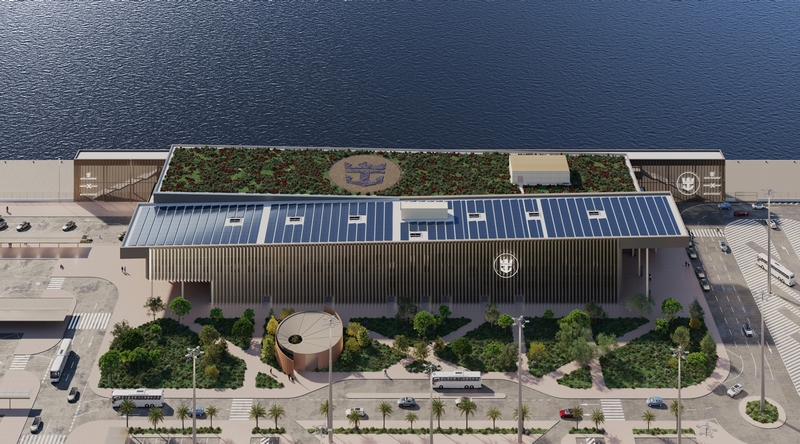
There, Reyna said, CTI has “gone above and beyond” — targeting Platinum LEED certification and a building designed to generate more energy than it consumes through solar panels and water recycling, with a multi-purpose layout for use when ships aren’t in.
“We’re trying to make the best use of the assets, and to integrate with interests and needs from the community,” he said.
Flexibility is the only honest answer to a terminal’s decades-long life cycle, he said, because much of what a building will need hasn’t been invented yet. He pointed to how quickly technology has thinned the traditional check-in hall.
“The Oasis of the Seas used to have 60 check-in counters. You go to Terminal A in Miami and you see eight now, and it’s an Icon-class terminal,” Reyna said. “In the future, maybe people just go through and their biometrics are detected. That allows us to create spaces that are more open and can potentially be multi-purpose.”
Those open halls are already drawing non-cruise interest.
Reyna said a terminal only works when everyone at the table wins: the cruise line, the port authority and the host community. He is skeptical of one-size templates for getting a community onboard.
“I don’t think there is a blueprint. It varies destination to destination,” he said.
Half a million guests might suit one port and overwhelm another that wants to cap itself at 300,000.
“It’s a dialogue with the local authorities and the stakeholders. You’ll be surprised how many people are not aware of the economic impact.”
Getting the sequencing right is its own discipline, he said, because every party runs on a different clock, including port authorities on multi-year dredging and procurement cycles, cruise lines on ships already on order.
“You look at the timeline, we’re thinking 10 years,” Reyna said. “How do you put them all in a sequence that actually works, minimizes delays and ensures a more efficient delivery? It’s important to have somebody like CTI who can actually place this on the timeline and keep the timeline.”
“Everybody recognizes there is a gap in infrastructure, so there’s plenty of projects to work on. We’re looking for places where we can make a difference, where we can create transformational change and very unique partnerships. When the community benefits, the community grows, and the cruise lines are happy because they have satisfied guests. In the long run, that’s the best situation for everybody, and it becomes a more resilient investment.”
Reyna was the one who made a case for a pier at CocoCay He said he ran a MTA-style regression analysis on decades of weather cancellations to prove a berth could be built.
“We found the rate of cancellation would decrease significantly,” he said. “When you build a pier, the experience is tremendously improved.”
The bigger ships that followed, he noted, brought the passenger economics that funded the amenities now synonymous with Perfect Day.
“The rest is history.”
His first CTI-style deal, though, dates back to 2004 and the Port of Roatán, where he helped convert a single-berth pier in Honduras into a functioning destination, reclaiming land, organizing taxi unions and building it, he stressed, with local talent.
“I didn’t do it alone. I did it with a local team,” Reyna said. “We need the local expertise, the local know-how and the local support. Whenever we find the combination of those three elements, that’s good for us.”
For all the terminals still on his list, that remains the test.
“There’s still opportunities out there,” he said. “The cruise business will continue to grow, evolve and bring positive effects to the communities, the ports and everybody else who supports it.”