Windstar Cruises is navigating change while it expands its fleet and deployment, according to President Chris Prelog.
Prelog noted that the current operational landscape is undergoing changes, requiring operators to adapt quickly to geopolitical and logistical hurdles.
“Every time I start a new year, I’m thinking, ‘Ah, we’ve got a really good plan.’ And then something happens,” Prelog said.
“Things are changing, and I think when you look at small ships, you absolutely have to manage the yield and prices.”
He added that a key advantage for Windstar is a nimble corporate structure that offers agility and energy, allowing for rapid decision-making.
“If things change, I’d rather be in a small company because we have meetings where we just get together and say, ‘Okay, this is happening. Here are three different solutions. What do we want to do about it?’ And that gets decided in a day, and we are moving forward,” he said.
Prelog also credited the line’s seasoned passenger base for providing a stabilizing force amid disruptions.
“The guests on smaller ships are generally more resilient. They’re more adaptable,” he noted, citing their extensive travel experience.
“They have traveled a lot, so they understand that the TSA lines may be long or that airports may be crowded or when flights get disrupted, and they’re just not blowing up on that anymore because the world is an ever-changing place,” Prelog added.
“They just know when they get on oard the ship, they will be fine because the disruption doesn’t really enter our vessels.”
Despite the flexibility small ships offer, Prelog said that financial challenges may arise when larger cruise lines are pushed out of certain markets or ports.
“In a situation like that, my commercial brain says, ‘Great, the big ships are done, so we can sail,’ and just really get access. But the operational mind gets reminded that we may see a 50 percent increase in port docking fees,” he explained.
“The small ships are also reliant on the big ships because the big ships are bringing contributions to the local community. If they’re not there anymore, they’re still needing the revenue to support the local community, so it’s actually getting more expensive for us.”
Looking ahead, Windstar is preparing for more capacity growth, adding another ship to its fleet this year.
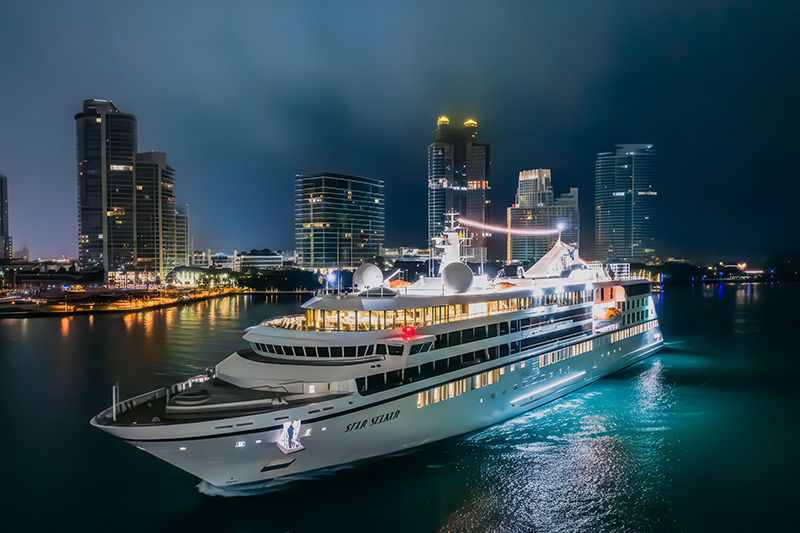
After welcoming the new Star Seeker in 2025, the company will introduce the Star Explorer in December.
A primary focus for this expanded capacity will be converting river cruise passengers to small-ship ocean cruising, Prelog said.
“We are tapping into guests who have seen all the rivers,” he added, noting that the company’s ships visit some of the rivers where these guests sail.
Geographic expansion is also on the horizon, with plans to operate two ships in French Polynesia in 2027.
While navigating these growth opportunities, Prelog explained that regulatory uncertainty remains a significant hurdle for the entire cruise industry.
“It’s pretty nebulous when you look at fuel standards and emission standards. The IMO requires every ship to have a shore power plug-in, but if you talk to the president of French Polynesia, he will say that they don’t even have enough power for the islands,” he explained.
“So there are different regulators out there, which makes it a bit more unclear for us.”