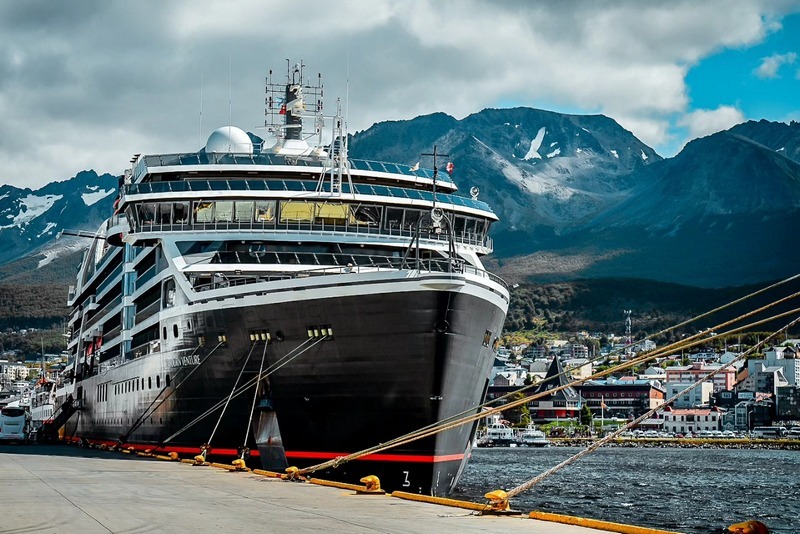
Port workers locked out of the Port of Ushuaia since January have now confirmed they will further escalate protest actions during the 2026-27 Antarctic cruise season.
They allege the port is operating under invalid safety certifications, potentially disrupting operations at the gateway to Antarctica for most expedition cruises, according to a new industry statement.
Franco Gastón Castillo, former administrative accounting director at the Port of Ushuaia and one of the representatives of the 140 workers removed from their positions following the federal government’s intervention, told Cruise Industry News earlier this month that protests would continue “for longer periods or for an indefinite time” during the upcoming season.
In a May 18 letter to international cruise industry stakeholders, the workers raised new concerns about port safety certifications.
The workers allege that the port is currently operating using PBIP port security certificates and environmental emergency plans that were issued to the Provincial Port Directorate, not to ANPYN, the federal agency now controlling the port.
“One of the most delicate points is that the terminal subject to the intervention continues to operate using certifications, authorizations and technical documentation that do not belong to the current imposed administration,” the workers stated in the letter.
The workers said the PBIP certificate, which authorizes the operation of container ships, passenger ships and fishing vessels and is valid until 2029, was issued by Argentina’s Coast Guard to the Provincial Port Directorate.
According to the workers, the original PBIP certificate disappeared under “unknown” circumstances days before the January 21 intervention.
The Coast Guard subsequently issued a duplicate, which was allegedly delivered to ANPYN and never sent to the Provincial Port Directorate.
“The central concern is that those who today administer the terminal displaced the technical and operational personnel who sustained those systems, while they continue using documentation and certifications obtained before the intervention to maintain an appearance of operational normality,” the workers stated.
The workers conducted two-hour roadblocks on the main artery leading to the port during the 2025-26 season, which ended in April. The protests caused delays for fuel trucks, food provisions, waste removal, maritime agents, passenger transport and other services essential to ship operations.
For the 2026-27 season, which begins in October, the workers plan to extend those actions.
“Basically, in principle, the same measures would be taken but now for longer periods or for an indefinite time,” Castillo said.
The workers are demanding the end of the federal intervention and reinstatement to their positions at the provincially-operated port.
The intervention began on January 21 when the National Ports and Navigation Agency took control of the Port of Ushuaia following allegations of financial irregularities and infrastructure failures.
According to ANPYN, 33 percent of the port’s budget had been used to subsidize provincial government accounts, in breach of regulations requiring port revenues to be reinvested exclusively in port infrastructure and operations, the Buenos Aires Times reported.
The workers have disputed these claims and provided documentation showing that Argentina’s Coast Guard certified on January 14 that the Port of Ushuaia met all international safety standards through 2029.
The port is now operating with 18 former Provincial Port Directorate employees who chose to work for ANPYN, supplemented by additional hires and private contractors, according to Castillo.
When asked about alternatives for cruise lines if protests disrupt the 2026-27 season, Castillo acknowledged that expedition cruises would likely avoid Ushuaia.
“I believe that given this is really an extraordinary situation, expedition cruises will much prefer to avoid any conflict and change course or go to the port of Punta Arenas as an alternative,” he said.
Punta Arenas, Chile, serves as the primary alternative gateway to Antarctica, though it is located further north than Ushuaia.