TUI Group’s cruise segment delivered strong first-half 2026 financial results, with underlying EBIT climbing 25.9 percent year-over-year to 163.5 million euros, even as the ongoing conflict in Iran weighed on operations and occupancy during the second quarter.
The company operates the TUI Cruises, Hapag-Lloyd Cruises and Marella Cruises brands.
Second-quarter underlying EBIT reached 80.3 million euros, a figure that absorbed approximately 20 million euros in charges directly attributable to the Middle East conflict.
The war’s most acute operational impact came from the stranding of Mein Schiff 4 and Mein Schiff 5 in Persian Gulf ports, which forced the cancellation of itineraries from April through mid-May 2026.
Both vessels departed safely on April 18 during a pause in hostilities, with full coordination and approval from relevant authorities, and are scheduled to resume Mediterranean summer season itineraries from mid-May.
Including the Iran effect, first-half occupancy came in at 93 percent, down from 97 percent in the prior-year period. Adjusted for the disruption, occupancy would have reached 98 percent, up one percentage point year-over-year.
Average daily rate across all cruise brands improved two percent to 223 euros despite the headwinds, while available passenger days grew 10 percent to 2.9 million, reflecting the segment’s ongoing capacity expansion.
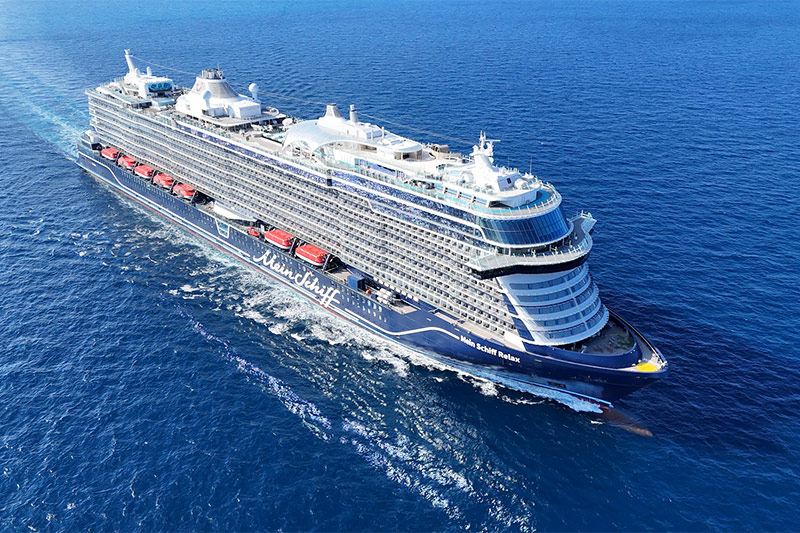
Mein Schiff Relax entered service in March 2025, and Mein Schiff Flow is set to join the fleet in mid-June 2026, adding further capacity as TUI moves to capitalize on what it describes as strong market dynamics.
For the second half of 2026, available passenger cruise days are projected to grow six percent, driven largely by Mein Schiff Flow’s addition. Booked occupancy for H2 (second half of the year) currently sits two percentage points below the prior-year level, a gap the company attributes entirely to the Iran-related cancellations. The average daily rate for H2 is tracking three percent above the prior-year period.
On the rate side, the segment’s H1 (first half of the year) average daily rate improved 0.6 percent to 217 euros, building on Q2’s 2.2 percent gain to 223 euros. TUI Cruises’ ticket revenue per achieved passenger day rose 1.0 percent in H1 to 211 euros, with Q2 coming in at 216 euros, up 2.9 percent. Marella Cruises, whose average daily rate captures the integrated nature of its fly-cruise product delivered a stronger H1 gain of 5.2 percent to £201, with Q2 rate reaching £205, up 5.7 percent year-over-year.