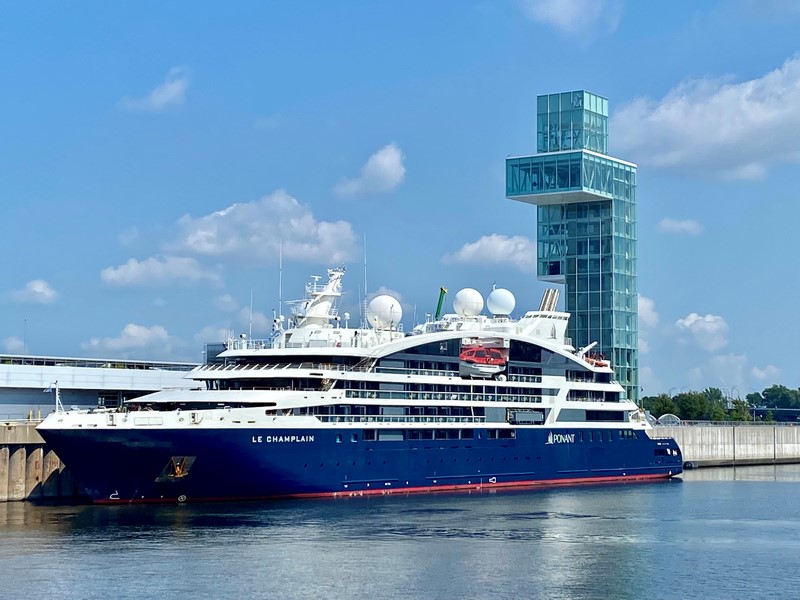
Ponant is targeting non-traditional cruisers and goal-driven luxury travelers, according to Samuel Chamberlain, chief executive officer, Americas.
Speaking to the challenge of attracting these guests who generally avoid cruising, Chamberlain noted that Ponant’s vessels act as a means of exploration rather than traditional cruise ships.
“I would argue that a lot of our expedition product caters to travelers that would never have considered a cruise, but use the ship as a vehicle to go to some of the most remote places in the world,” he explained.
He pointed to the company’s winter operations in the St. Lawrence River as an example, describing it as an ice safari featuring snowshoeing and dog sledding after breaking through five feet of ice.
“You see these different viewpoints around the ship being the destination, the ship being a tool to go see a destination, and Ponant is all about exploration,” he continued, noting that the company’s vessels become a conduit for this exploration.
“When you think about a circumnavigation of Iceland compared to the land alternative, or really immersing yourself in the destination like Sicily; there are a lot of land travelers out there that might consider small ships as that different viewpoint.”
This immersive approach aligns with a shifting luxury demographic that Chamberlain described as highly dynamic and focused on special interests, such as golf.
“One of the super trends of luxury travel and luxury travel mindset right now is that it’s very results-driven,” he added. “They have a goal, they have an interest, they want to be pursuing something.”
Chamberlain said that time is the most precious resource for luxury travelers, noting that guests will switch itineraries rather than cancel trips if challenges arise in specific regions.
He highlighted Ponant’s presence in over 400 deployments that visit 110 unique countries, adding that while some destinations are currently seeing softer demand, others are moving fluidly with the luxury traveler to make sure that they still take that holiday.
Looking ahead, Chamberlain identified a significant industry opportunity in capturing Gen Z travelers, whom he described as asset light and experience heavy.
He suggested that the cruise industry currently lacks the sophisticated points-based or credit card loyalty schemes that hotel and airline brands use to bring younger guests into the booking funnel.
“They want to be using points and consuming. And the barrier for them to use our product is that it is an aspirational product,” Chamberlain said.
“There is a gap in the cruise industry right now on that loyalty scheme of bringing people into the funnel. That’s our future traveler of tomorrow.”