As MSC Cruises continues to expand its LNG-powered fleet and explore next-generation ship designs, the company is focusing on building vessels capable of exceeding current sustainability targets over a three-decade lifespan, according to Chief Energy Transition Officer Michele Francioni.
Cruise ships designed today will enter service in five years and operate for 35 years or more, he noted.
As such, the vessels being built today must be designed to sail well beyond the industry’s current sustainability targets.
Francioni called this a key element in ship design, noting that it presents both a significant challenge and a significant opportunity — particularly around the introduction of new technologies.
LNG is MSC’s current choice for cleaner operations and, far from a stopgap measure, Francioni said, is a proven reality that delivers both energy security and operational efficiency.
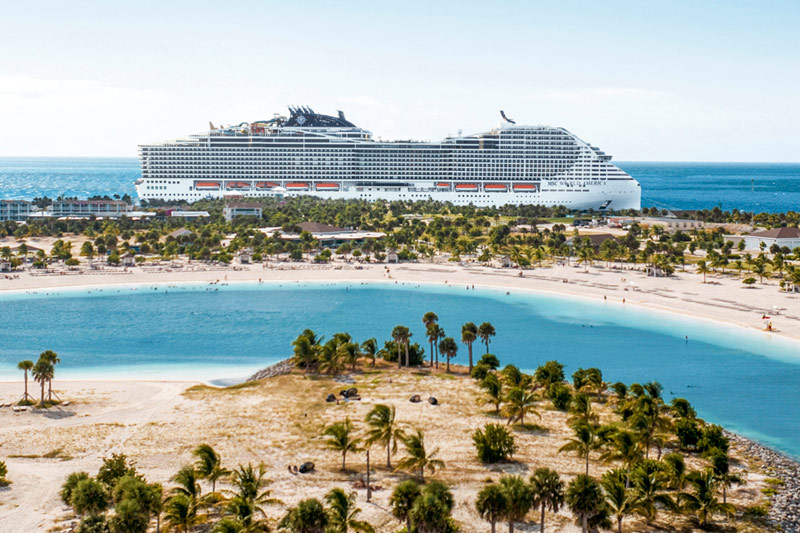
The company currently operates three LNG-powered vessels: the MSC Euribia, MSC World Europa and MSC World America.
While regulatory uncertainty remains, the company has been exceeding its targets with the fuel, Francioni said.
“The year 2025 was a very good one for our fuel implementation in Europe, in which we actually met our target and created a surplus in both LNG and bio-LNG.”
That, he said, is proof that MSC has made the right call on its fuel strategy.
As part of the company’s World class series, six additional vessels powered by the fuel are set to enter service in upcoming years, including the MSC World Asia in 2026 and the MSC World Atlantic in 2027.
MSC has also recently ordered four next-generation ships forming a new class called New Frontier, with deliveries beginning in 2030.
While the vessels are expected to operate using alternative fuels, details of their energy systems were not confirmed at press time.
The evolution of fuels and other technologies brings changes that must not come at the expense of safety for passengers, crew or communities, Francioni said.
Yet if not managed correctly, these new assets introduce challenges on both the safety and sustainability fronts, he added.
“A big challenge is ensuring that the crew is fit for purpose and well-trained to deal with these technologies,” Francioni noted.
New technologies also bring opportunities, he continued, pointing to artificial intelligence (AI) as a prime example.
“We implemented a very successful project using AI with our air conditioning, which is an area that has a very significant energy demand,” Francioni said, mentioning that the systems can use several megawatts.
“By simply optimizing what we call the concentration or the chiller water, we were able to save an enormous amount of energy,” he continued.
To achieve those gains, the company used AI to analyze millions of pages of data, Francioni said.
With ships being highly complex structures, he added, the challenge lies in identifying the right products and applications that can actually make a positive impact on operations.